INSPIRE Land Matters Project, Webinar May 2026 – Key Insights and Lessons Learned.
In the evolving landscape of Renewable Energy project development on government-owned and communal land in South Africa, the Land Matters Practice Development process is testing a different approach to project development and implementation, one that places learning, reflection, and collaboration at the centre.
Since May 2025, INSPIRE and commercial renewable energy developer, Forethought Capital, have met regularly under the Land Matters project to make better sense of and share lessons about the complexities of land governance, community engagement, and commercial project development. These encounters have sought to be open, honest, and grounded in practice, and have generated interesting insights. As part of the learning and reflective practice, the Land Matters project has sought to broaden the engagement and consider diverse perspective
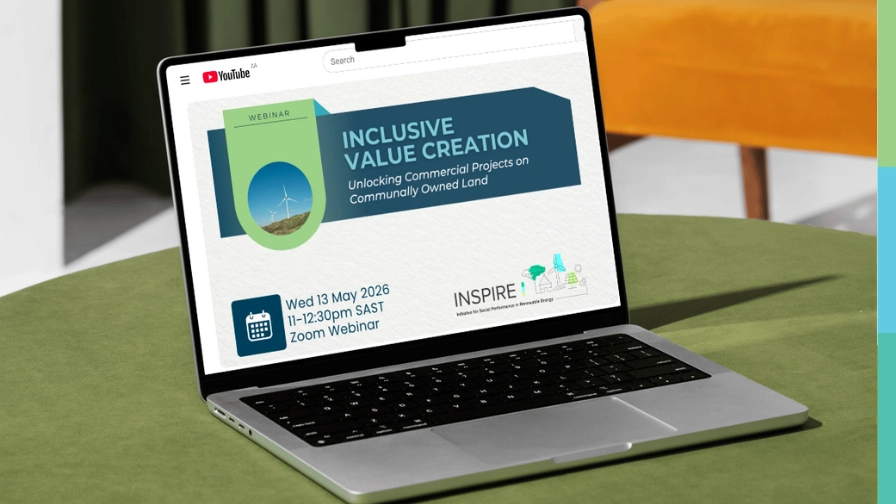
This blogpost – “Inclusive value creation: Unlocking commercial projects on community-owned land” – is the third in a series of offerings on practice development, made for the wider renewable energy community. It offers the key insights and lessons learned from a webinar hosted by INSPIRE on 13 May 2026 in which Tessa Brewis (Cliffe Dekker Hofmeyr), Nokwanda Sihlali (UCT LARC) and Methuli Mbanjwa (Forethought Capital) reflected on different perspectives of what it took and to be considered when pursuing commercial development on community – owned (or communal) land.
South Africa’s renewable energy transition is simultaneously a technical, commercial and social undertaking. Many of the areas with high potential for wind and solar development are situated on communal areas, where millions of rural South Africans live, farm, and hold deep ties to place and history. The extent to which those communities become active participants in the energy transition is itself a determinant of whether the transition is truly inclusive and equitable.
For INSPIRE and Forethought Capital, it is a straightforward proposition: inclusive renewable energy development is possible when legal and commercial assurance is matched with trust, participation, and collaborative practice. The webinar – “Inclusive value creation: Unlocking commercial projects on community-owned land” – set out to explore and share insights on that proposition through highlighting complexity, challenging assumptions, and deepening understanding.
The section below highlights the key takeaways from the webinar and identifies the main reflections and insights relevant to the development and implementation of projects on communal land.
WHAT EXISTS, BUT IS NOT YET FULLY USED
Communal land rights are legally enforceable, but generally not well understood
One of the foremost considerations for developers and investors in renewable energy projects is the assurance of land rights and tenure security, as these are critical to the project’s feasibility, financing, and long-term sustainability. This assurance is often less understood on communal land in South Africa, particularly in relation to the processes governing the acquisition of land rights for projects. Under the South African Constitution and the Interim Protection of Informal Land Rights Act (IPILRA), communities hold legally recognised rights over communal land, even without formal title deeds. In other words, even in instances where there is an absence of a title deed in the name of the community, = there are still enforceable land rights, which can also be contemplated for projects.
“People will tell you that ‘me living here is me being a title deed.’ The paper in the deeds registry does not recognise the relational, layered nature of these land rights.” Nokwanda Sihlali
However, IPILRA is not a permanent fixture of the statute book as it requires periodic renewal. When it has expired or under review during any renewal period, its provisions continues to apply.
Additionally, the term “informal,” which is commonly used to describe communal land rights, can be misleading. The Act provides for the formal recognition of these rights and establishes legal protections and mechanisms for their enforcement. Importantly, other communal land rights are layered (such as cultural heritage, spiritual, ancestral or customary practices), constitutionally grounded, and are not adequately captured by formal property legal concepts.
The financial system is adapting, but slowly
While there has been a limited number of projects on communal land, banks do not inherently object to financing projects on communal land. What they require is certainty that the land is secure for the full project lifetime. Project land rights can be obtained through the provisions of IPILRA and applicable policies that include ministerial consent to enter into a registerable lease. The real barrier is that some lenders and legal practitioners who do not yet understand communal tenure systems may classify their = unfamiliarity and/or limited examples as risk, raising the cost of finance or making it unavailable.
“The lack of certainty can be overcome. It is certainly seen as an obstacle, but without security of tenure for the full duration of the project, it becomes impossible to unlock the funding.” Tessa Brewis
As sector-wide understanding improves, this barrier is expected to reduce. Developers with strong reputations for genuine community engagement are already finding it easier to secure finance for commercial development on communally owned land. The path exists; the task now is to make it more familiar.
CHALLENGES TO PRACTICE, POLICY AND STRATEGY
Trust precedes process and communities protect what they have genuinely chosen
Meaningful community engagement cannot be compressed into a procedural consent process. Multiple engagements are typically required with community before formal processes can be progressed, because communities assess developer intent before they assess commercial terms.
“You probably have to come three or four more times before the letter of consent is even read, because trust is more important than the intrinsic commercial value you have on paper.” Methuli Mbanjwa
Where communities have genuinely agreed to a project proposal, they become some of its most invested protectors, including against internal opposition. Engagement that is procedurally complete but not genuinely participatory carries significant risk of future disputes, difficulties securing finance, and loss of social licence to operate.
Social feasibility is a gap in standard practice
An early-stage assessment of whether a community wants development on its land, on what terms, and through what governance structures – what might be called “social feasibility” – was identified as a one of the critical elements to be factored into the conventional project development process. It is, at least, as important as financial and technical feasibility assessments, but has not yet been standardised or institutionalised across the sector.
The procurement framework structurally disadvantages communal land
Current competitive procurement programmes require developers to compete on price within fixed timelines. The additional time, cost, and administrative steps required for communal land projects, including gaining ministerial consent which is required under IPILRA, place them at a structural disadvantage relative to projects on privately owned land.
There are multiple proposals on how the government renewable energy procurement framework could respond. Two were explored in the webinar. One is a procurement mechanism specifically designed for communal land contexts, with adjusted timelines, different risk parameters, and evaluation criteria that reward genuine community engagement. Another consideration would be to award additional points as part of the evaluation process to bids by projects developed on communal land, recognising the additional investment required and socio-economic value towards the community. While there are now multiple pathways for offtake in South Africa beyond the government procurement programme, the above approaches could incentivise outcomes for communities.
A just transition requires more than green credentials
Renewable energy development on communal land does not automatically constitute a just transition. A just process requires that those directly affected are genuinely included, not only at the outset, but throughout. Furthermore, it requires recognition that communities are not homogeneous, that governance structures vary significantly across contexts. Considerations for engagement and participation should be inclusive and that women must be recognised as key decision-makers.
“A just transition cannot simply replace extractive industries with green development if the underlying power imbalances remain unchanged.” Nokwanda Sihlali
Land carries spiritual, cultural, and livelihood values that cannot be fully captured in financial compensation frameworks. Replacing extractive industries with green development while leaving underlying power imbalances unchanged is not a just transition.
FUTURE POTENTIAL
Community ownership is worth pursuing
Community ownership of renewable energy projects, beyond standard community benefit and Broad-Based Black Economic Empowerment equity provisions, currently averages approximately eight percent, and there is room to increase this significantly.
Models to promote community ownership also exist internationally. An example in South America is where a development advisory company does not take project equity, and instead builds community capacity to own and govern projects outright on their own land. The South African context is different, but the principle is transferable. Communities that are landowners hold real leverage in negotiations; the opportunity is to build capacity so that they are better informed and prepared enough to use it.
Preparatory work matters here. Communities that have already clarified the status of their land rights, agreed on who is authorised to represent them in negotiations, and built a shared understanding of the risks and opportunities of development are far better placed to engage on their own terms, rather than under time pressure, once a developer has already arrived.
“I will invest money because the trust that I’ve been given now is enough for me to move ahead.” Methuli Mbanjwa
The webinar closed with shared recognition that inclusive commercial development on communal land is not only possible; it is already happening. Now, what is essential, is a sector-wide commitment to form meaningful relationships and build long-term trust with communities on communal land, and to recognise the value of proposed infrastructure project is inextricably linked with social feasibility. The understanding of the context and governance process for communal land rights is equal importance to legal clarity and commercial certainty. Furthermore, building the tools, frameworks, practices and institutional knowledge that make this the norm rather than the exception will involve significant work and investment. The Land Matters Project continues to document, share, and learn from that work.
![Unlocking Value [-Creation] Through Renewable Energy Projects on Communally Owned Land: Insights from the Land Matters Roundtable](https://inspire-excellence.net/wp-content/uploads/2026/08/Land-Matters-Roundtable-2026.webp)