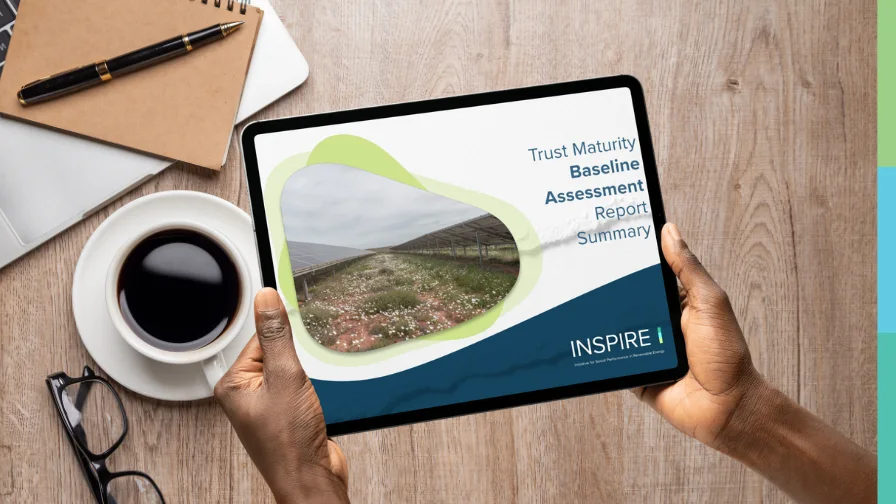

Following our open-call to Community Trusts to complete the Trust Maturity Self-Assessment, INSPIRE hosted its first 2026 Trust Matters webinar this March. The webinar focused on sharing the results from this open-call, which we have collated and anonymised into our Trust Maturity Baseline Report. The webinar also unpacked our findings and shared learnings and experiences from the trusts who shared their results with us.
Trusts Maturity levels across South Africa
The report findings, presented by Ephraim Mbeletshie of Embedding Impact, revealed that most trusts fall between Early and Maturing stages, with none yet reaching the Leading Practice stage of Trust Maturity. The results also showcase the average levels across all 4 elements of the Trust Maturity Framework:
- Governance – shows solid foundations, with structures and accountability largely in place.
- Vision and Strategy – encouragingly, this element emerged as a clear strength, many trusts have defined missions and long-term direction
- Capacity and Impactful Delivery– both lagging behind, this highlights challenges such as limited staffing, weak systems and infrastructure constraints. Monitoring, evaluation and learning practices also remain underdeveloped, making it harder to track progress and adapt effectively.
A consistent theme throughout the findings is the disconnect between planning and implementation. Trusts know what they want to achieve, but often lack the systems, resources and capacity to deliver consistently.
What Drives Stronger Trusts
The report highlights a few consistent drivers of higher maturity:
- Clear and well-documented governance systems
- Strong alignment between strategy and community needs
- Balanced delivery models, combining internal capacity and external support
- Reliable funding that enables investment in people and systems
Reflections from Trusts
After presenting findings, we were joined by Curtley Rens, Trustee and Secretary of Gouda-Saron Wind Energy Community Trust. Curtely opened with a powerful remark, “Before using the self-assessment tool, the trust operated in a disorganised and unfocused way, often handling matters inconsistently. The introduction of the tool provided much-needed structure, helping trustees to better understand their work, align around their vision and assess their progress.”
Curtley describes how the trustees initially worked on the tool together but later broadened the process by involving the wider community, including ward councillors, committees and local organisations. This engagement proved valuable as it strengthened relationships, improved transparency and ensured that the trust’s vision was shared and understood by the community.
We were pleased to learn more about how the self-assessment results also helped the trust to clearly identify gaps and focus areas. As Curtley mentioned, “Where there was previously confusion, there is now clarity on priorities and the steps needed to improve.”
Watch the Webinar
Looking ahead: The Trust Matters Cohort Support Programme
We will be journeying with Trusts in a programme aimed at strengthening their capacity. The programme will provide Trusts with a gap analysis and tailored support to assist them in achieving higher Trust Maturity levels. Participating Trusts will also benefit from maturity development plan, clear metrics and tools.
We invite Trusts that have not yet completed the Trust Maturity self-assessment to do so, to identify areas of strengths and opportunities for improvement. Trusts are not obligated to share their results with INSPIRE, but those willing to do so may contact Avela: avela@inspire-excellence.net