The 2026 Alternative Mining Indaba gathered leaders from civil society, community organisations, the private sector and policy spaces under a bold theme: Power to the People: Owning Africa’s Energy Future.
Co-hosted by the Business & Human Rights Resource Centre (BHRC) and INSPIRE, the two-day workshop asked a question that refuses to go away: What would it take to make Africa’s energy transition truly just?
Across both days one truth echoed through the room – the transition is not only technical, it is also historical, social and political and it must centre rights-participation and shared prosperity.
Day 1: Responsible Resources and Human Rights
Day 1 focused on the extractive economy and transition minerals that power renewable technologies, and also carry deep human cost. The conference was opened by Joseph Kibugu, Africa Regional Manager at the BHRC. Speakers included Michael Clements, Jyrki Torni, Adv Sandra Maokosha, Ontlotile Seemela and Kiren Rutsch, who discussed the importance of strengthening human rights commitments in projects. In his opening remarks, Joseph Kibugu positioned Africa not as a secondary player, but as a central force in the global energy transition. He highlighted a stark contradiction that while Africa supplies critical minerals essential for renewable technologies, less than half of its population has access to reliable energy. This framing established the core tension of the conversation, a continent powering the transition externally while facing energy poverty internally. His remarks called for reframing Africa’s role from passive participant to an essential stakeholder, emphasising responsibility, equity and inclusion in shaping the transition.
A keynote address was delivered by Jyrki Torni, EU Delegation to SA-Head of Section: Global Gateway, Infrastructure & Green Transition. In his address Jyrki emphasised that the European Union is strengthening its partnerships with resource-rich countries to ensure that the growing global demand for critical raw materials is driven by the green and digital transitions including the growth of artificial intelligence, all which have significantly increased global demand for critical raw materials (CRMs), many of which are sourced outside Europe. Resource-rich countries therefore face both opportunities (economic development, jobs, industrialisation) and risks (pollution, biodiversity loss, human rights violations, corruption).Jyrki’s speech highlighted the EU’s commitment to ensure that the race for transition minerals strengthens governance, protects the environment, respects indigenous and labour rights and generates long-term shared benefits for local populations.
In her address, Michael Clements, the Executive Director of BHRC echoed the sentiments of her colleagues and speakers, that responsible business conduct and respect for human rights should be the rule, not the exception. Emphasising that the global energy transition requires structural reform of power, ownership and benefit sharing systems that have historically concentrated wealth. A just transition must prioritise meaningful participation, shared prosperity, human rights protections and safeguards for defenders and that ignoring human rights undermines long-term stability and climate goals.
Day 2: From Responsibility to Real Ownership
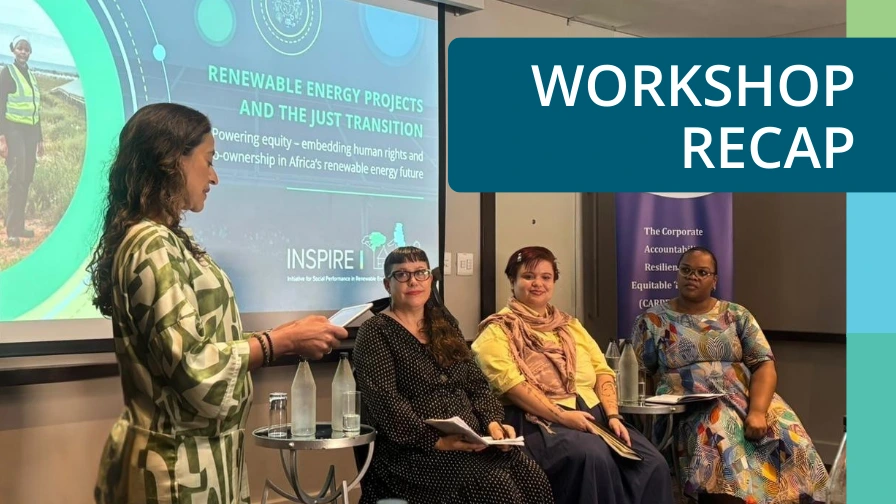
The second day convened under the theme Renewable Energy Projects and the Just Transition and moved from policy theory to lived implementation as INSPIRE hosted two candid panels.
The first panel hosted by INSPIRE was titled, What Can Renewables Learn from Mining—and Vice Versa
This panel was moderated by Yumnaa Firfirey, and the panellist were Bianca Jordan, Celiwe Mabaso and Janine Tilley.
The moderator opened the panel session with a powerful question that set the tone for the day, ‘is fairness and equity in renewable energy projects guided by binding standards, or does it depend on the discretion of individual practitioners?”
This statement, a reality of how justice is operationalised within projects under the REIPPPP and C&I construction phases. While community trusts and ownership are highlighted in policy framing, during implementation this is not the reality, with ownership not featuring more prominently in day-to-day construction decisions.
While all panelists agree that the transition must focus on more than increased megawatts, the reality is less straightforward. The Renewable Energy Independent Power Producers Procurement Programme (REIPPPP) mandates a minimum of 2.5% equity to local communitities, but they have little to no influence over strategic decisions on these projects – and ownership without voice is incomplete.
One of the most debated statements was that “It’s not our business to create jobs. It’s our business to provide energy.” A panellists responded firmly that merging industries create ecosystems and ecosystems create jobs. She argued that the sector has focused on the energy transition while neglecting the “just” dimension. She further emphasised that communities who understand procurement values and project finance should not be treated as risks and that transparency about project value and local benefit should not be threatening if practice is sound.
Another panellist highlighted the issue of job creation during the construction phase, emphasising that companies have limited permanent roles during operations. In contexts of deep unemployment, communities understandably equate opportunity with employment. There needs to be a shift in expectations towards enterprise development, local supply chains and longer-term economic participation, which all requires careful engagement and credible partnerships. She also highlighted a recurring issue of the instability of municipals and the political cycles, which further complicate integration into local development planning.
Our moderator wrapped up this powerful session by locating present inequality within apartheid, colonialism and slavery. Emphasising that many businesses operating today have benefitted from these systems and therefore the responsibility for redress cannot rest solely with the government…
The second panel that was hosted by INSPIRE was titled, Community Ownership and Community Engagement in Utility-Scale Renewables
Moderating this panel was Lisa Van Dongen, and the panelists were Sinazo Nkwelo, Fowzia Davids and Yumnaa Firfirey
Our moderator for this panel moved the conversation from responsibility to ownership and benefit sharing under REIPPPP.
One of our panellists, started the session by unpacking the structure of community trusts under the current REIPPPP. She also highlighted a crucial factor which is that communities frequently secure loans through institutions such as the Industrial Development Corporation or the Development Bank of Southern Africa and repay these through dividends. On paper this is groundbreaking because rural communities co-own infrastructure assets. However, ownership can exist without meaningful influence- communities may hold equity while remaining silent partners in decision-making. Ownership without voice is incomplete
One of the panellists shared practice insights from the ground and highlighted that early trust funding often resembled reactive grant-making and through workshops and needs assessments, trusts are now moving towards strategic focus areas such as education, health and livelihoods.
While we are seeing some community trusts progress through facilitated workshops, needs assessments and community visioning, we are still faced with the basic questions:
- Who speaks for the community?
- How do you prevent politicisation?
- How do you move from charity to strategy?
The room was further challenged to focus on outcomes rather than outputs. Infrastructure and donations matter, but transformation requires evidence that lived conditions are shifting. Even R25 million annually injected into a rural economy is significant, yet it is small relative to systemic poverty.
And the harsh truth is that Trusts alone cannot carry the weight of systemic inequality.


Combined Reflections: Reclaiming the “Just”
The two-day gathering covered several themes, including:
- Equity must be structurally embedded, rather than dependent on goodwill.
- Transparency builds legitimacy.
- Ownership without participation is hollow.
- Job creation is complex, but business cannot ignore its developmental footprint.
- Strategy must replace reactive funding.
- Outcomes matter more than outputs.
- Collaboration is essential for scale and sustainability.
- The “just” in Just Energy Transition demands shared responsibility.
As large-scale renewable energy projects inevitably shape local economies, we need to move conversations enterprise development, local procurement, small scale agriculture, social ventures and long-term community capacity.
The renewable energy’s sector real measure of success will not be installed capacity alone.
Closing remarks
Africa’s energy transition stands at a defining moment, caught between a history of extraction and the possibility of real empowerment. The conversations over these two days exposed the contradiction clearly. A continent rich in critical minerals continues to face deep energy poverty. Community trusts under REIPPPP may hold equity on paper, yet too often remain excluded from meaningful decision-making. Even significant annual injections into rural economies make a difference in people’s lives, but they are not enough to undo structural inequality. And while renewable energy projects are built to generate power, they inevitably shape local economies through procurement, enterprise development and supply chains, which means job creation and long-term participation cannot be treated as someone else’s responsibility.
This 2-day workshop reminded us that today’s inequalities are rooted in apartheid, colonialism and slavery and that the burden of redress cannot fall on government alone. Ownership without participation is hollow. Transparency should be standard practice, not a threat and community trusts cannot carry systemic injustice by themselves. If the “just” in the Just Energy Transition is to carry weight, it must move beyond policy language and minimum equity thresholds toward binding standards, credible partnerships, genuine community voice and clear evidence that lived conditions are improving.
Thank you to BHRC for convening the space and to all the panellists for their thoughtful contributions.
Africa is already powering the global transition. The question now is whether that transition will meaningfully return power to its people.