What does it take to develop commercially viable renewable energy projects on communal land while ensuring that communities are meaningful participants in the process and share in the opportunities created?
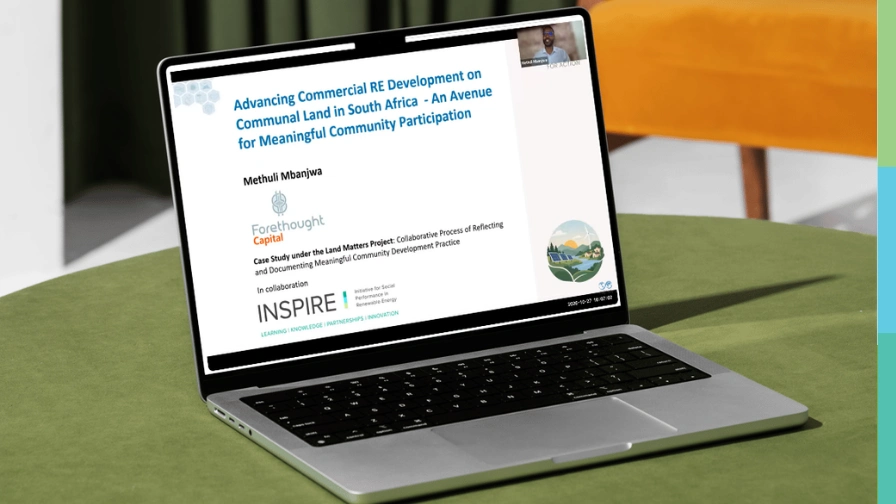
This was the question explored by Methuli Mbanjwa of Forethought Capital, representing the Land Matters Project, at the International Renewable Energy Agency (IRENA) Coalition for Action’s second webinar in its Renewable Solutions for Vulnerable Communities series.
Titled Powering Indigenous Communities: Co-ownership, Participation, and Equitable Benefit-sharing, the webinar brought together experiences from South Africa, Madagascar, the United States and Canada to explore how renewable energy development can better recognise community rights, support local empowerment and create more equitable outcomes.
Drawing on Forethought Capital’s experience developing two solar projects on communal land in Limpopo, South Africa, Methuli shared insights into how commercial renewable energy projects can work alongside community land rights, governance structures and development priorities.
Understanding the communal land context in South Africa
Communal land in South Africa is shaped by a history of dispossession and exclusion from formal land ownership. Many rural communities continue to occupy and use land under customary and communal tenure arrangements, without holding individual title deeds.
These communities nevertheless hold constitutionally recognised land rights and have established governance structures that remain central to community life and decision-making.
For renewable energy developers, this creates a particular set of considerations. The requirements of commercial project development, land rights acquisition and bankability do not always align neatly with existing communal land arrangements.
However, communal land should not be viewed simply as a barrier to renewable energy development. With appropriate processes, relationships and frameworks in place, it can support commercially viable projects while creating opportunities for rural economic development, local benefit-sharing and more inclusive participation in South Africa’s energy transition.
The Land Matters Project: Creating space for reflection and learning
The Land Matters Project involves intentional social performance and related practice development for two LimpopoThe Land Matters Project involves intentional social performance and related practice development for two Limpopo-based solar projects under development on communal land.
Hosted and facilitated by INSPIRE, the project provides a platform for stakeholders to reflect on their experiences, generate shared knowledge and document meaningful community development practice.
Through a collaborative process, the project seeks to ensure that social performance learnings are not only experienced in practice, but also processed, understood and documented in ways that can inform future renewable energy development.
Methuli’s presentation drew on this experience to demonstrate how commercial renewable energy development on communal land can progress while creating opportunities for communities to participate meaningfully in the process.
Lessons from practice: What enables meaningful participation?
The presentation highlighted several important lessons from Forethought Capital’s experience.
1. Communities are willing partners, not passive stakeholders
Communities should be recognised as partners in renewable energy development, rather than simply recipients of project benefits or participants in a once-off consultation process. Their involvement and perspectives are important throughout the development process.
2. Relationships matter more than signed agreements
Formal agreements are important, but they cannot replace meaningful engagement and the relationships needed to build trust. Investing time in understanding community contexts and establishing constructive relationships is essential.
3. Established frameworks can enable communal land projects
Working within existing communal land arrangements requires an understanding of the relevant rights, governance structures and decision-making processes. Appropriate frameworks can help bridge the requirements of commercial development and the realities of communal land ownership and use.
4. Bankability starts with those willing to move first
Developing renewable energy projects on communal land requires patience and resilience. Progress depends on stakeholders being willing to engage with the complexities, work through challenges and demonstrate that these projects can be achieved.
5. Benefit-sharing and participation must be integrated early
Opportunities for community participation and benefit-sharing should be considered from the outset, as part of project design, rather than treated as additional considerations once commercial arrangements are already established.
6. Commercial success and community impact can go hand in hand
The experience demonstrates that commercial renewable energy development and positive community outcomes are not mutually exclusive. With the right approach, projects can contribute to local economic development while advancing South Africa’s renewable energy ambitions.
Making the energy transition more inclusive
South Africa’s renewable energy transition presents significant opportunities for investment, employment and economic development. However, the way projects are developed matters just as much as the capacity they deliver.
The experiences shared through the Land Matters Project demonstrate that commercial renewable energy development on communal land is achievable. They also reinforce the importance of intentional social performance practice, strong relationships and early consideration of community participation and benefit-sharing.
As Methuli’s contribution to the IRENA Coalition for Action webinar highlighted, the energy transition can create opportunities for both commercial success and meaningful community development. The challenge, and the opportunity, lies in ensuring that these outcomes are pursued together.