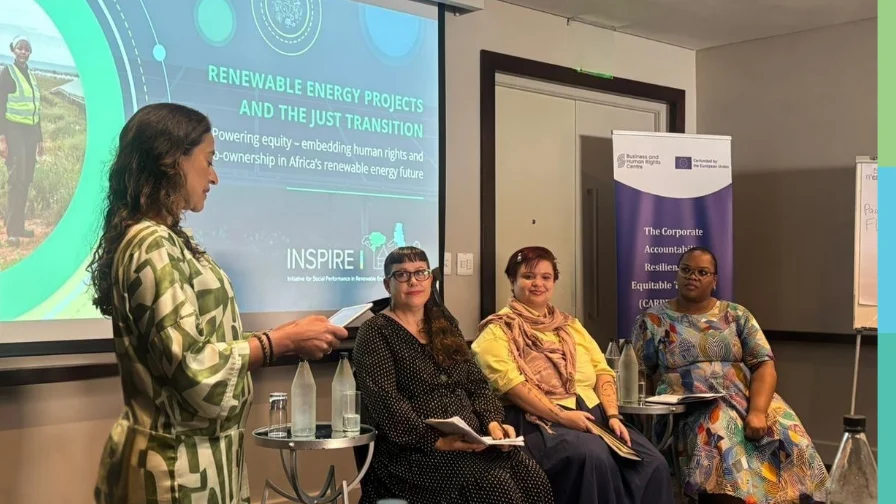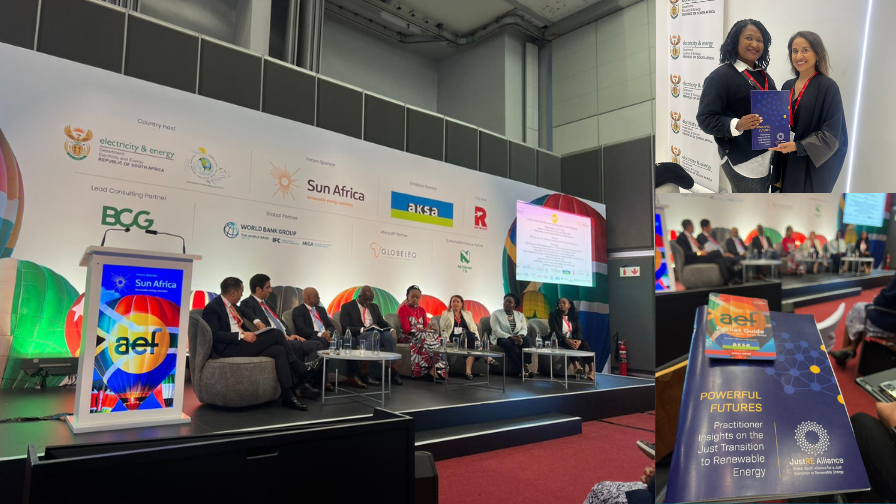
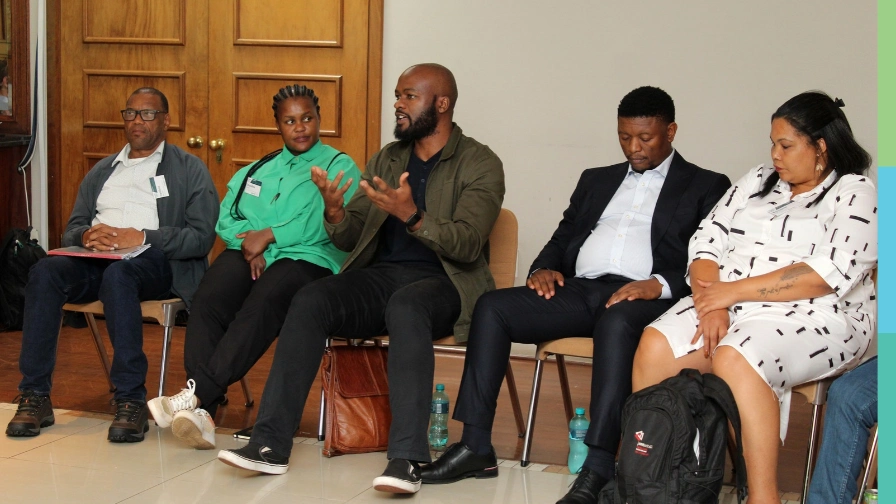
On 5 August 2026, INSPIRE supported a capacity-building session for stakeholders working on the Koruson Cluster of Renewable Energy Farms. Delivered under INSPIRE’s Knowledge Partnership MOU with the Eastern Cape Department of Economic Development, Environmental Affairs and Tourism (DEDEAT), and in support of the Northern Cape and Eastern Cape Offices of the Premier, the session brought together representatives from both provinces, affected municipalities and, the developer, ahead of the MOU’s finalisation.
INSPIRE partnered with Nexus Impact Partners (NIP), who developed and delivered a presentation aimed at strengthening the forum’s understanding of the formal procedures and rules governing Socio-Economic Development (SED), Economic Development (ED) and trust operations across both REIPPPP and commercial and industrial (C&I) projects. The session was proposed as a preparatory step, equipping provincial and municipal officials to engage critically with terminology, models and obligation in the community investing landscape before the proposed MOU comes back to the table for final review.
Framing the Discussion
The session was opened by Mr Rupert Fortune from the Eastern Cape Office of the Premier, welcoming everyone and setting the scene for the day’s proceedings. We shared more about INSPIRE’s mandate and current initiatives and the role Nexus Impact Partners would be playing in the training-the session’s premise was local benefit from renewable energy development is not discretionary, it is part of the development bargain. Nexus then framed the day around four pillars that recur throughout any conversation on community benefit, economic participation, social investment, voice and remedy, and long-term stewardship, and used these pillars to anchor two modules of applied learning.
Module 1: Demystifying the Sector
The first module unpacked the different role players in a renewable energy project; the IPP, EPC, OEM and Trader and, which of these actually carries a community-benefit obligation. Only the IPP does, the EPC, OEM and Trader answer to generic B-BBEE codes, not to REIPPPP, a distinction Nexus returned to throughout the session as it directly shapes where accountability for community benefit sits.
Participants were walked through the difference between REIPPPP’s ED obligation, calculated as a fixed percentage of project revenue and accruing regardless of profitability, and generic B-BBEE spend, which is calculated against net profit after tax and fluctuates with it. Which explained a pattern the forum can expect to see in the cluster’s early years: as debt service on project finance keeps profit thin, B-BBEE-linked spend may look small even while the REIPPPP obligation keeps accruing on revenue, unaffected.
Nexus applied this framework to the different project structures within the Cluster in review, including projects operating under REIPPPP and private C&I arrangements, as well as the respective roles of EPC, OEM and Trader contractors. This practical application enabled participants to consider how different regulatory and commercial frameworks shape community-benefit obligations, reporting requirements and accountability across a multi-project environment. The discussion highlighted the importance of distinguishing between these frameworks when considering the MOU, particularly to ensure that the commitments, responsibilities and associated reporting mechanisms applicable to each project are clearly understood by all parties.
Module 2: Community Ownership Trusts
Nexus outlined three distinct roles within a community trust. Trustees are responsible for governance, exercising independent judgment and safeguarding the interests of beneficiaries. Management is tasked with implementing approved plans and maintaining accurate records, while the founder or IPP plays a supportive role by providing information, resources, and capacity-building without influencing beneficiary decisions or exercising control over trust assets. Particular emphasis was placed on the founder’s role in these structures. While the founder’s support is intended to strengthen the trust’s independence and effectiveness, control can compromise that independence.
Participants learned that trustees can only act once the trust’s authority has been formally established through the trust deed, trustee appointment, registration with the Master of the High Court, and ongoing compliance with fiduciary duties and disclosure requirements.
Three structural models were compared: a Single SPV Trust, a Super Trust and an Umbrella Trust each carrying different trade-offs between community linkage, decision speed, professional capacity, cost efficiency and accountability. Any pooled structure, needs binding safeguards regardless of which model is chosen: ring-fenced sub-funds, community representation that cannot be overridden, reserved decisions, transparent reporting and independent grievance mechanisms among them.
The discussion provided an opportunity to consider the proposed shared trust structure being proposed by the developer to coordinate governance across the cluster, including the use of Eastern Cape and Northern Cape provincial sub-funds intended to preserve the respective provincial allocation arrangements. The proposed structure provided a practical case through which participants could explore the governance considerations associated with pooled community ownership arrangements. These included representation, reserved decisions, disclosure, grievance mechanisms, the protection and reporting of sub-funds, and the respective roles of trustees, beneficiaries and project partners.
The training did not seek to determine the final governance model, but rather to strengthen stakeholders’ understanding of the considerations that may inform the MOU process as the proposed arrangements are further developed and finalised.
Carrying the Learning Into the MOU
The session closed by translating the day’s learning into a set of practical considerations for the forum as the MOU progresses towards final review. These included how SED, ED, B-BBEE and CSI commitments will be identified and reported across different project structures; how the respective obligations associated with REIPPPP and C&I projects will be understood within the broader cluster; how trustee appointment and community representation will operate; how Provincial Sub-Funds will be allocated, protected and reported; and what mechanisms will enable the governance arrangements to be reviewed and adapted over time.
These questions reflected the purpose of the capacity-building session: not to prescribe the outcome of the MOU process, but to strengthen the shared understanding required for government, developers and other stakeholders to engage constructively with its provisions.
Closing Reflections
The training demonstrated the importance of establishing a shared understanding of the regulatory, commercial and governance frameworks that underpin community benefit in renewable energy development. While terms such as SED, ED, B-BBEE, CSI and community ownership are commonly used across the sector, the session highlighted that their application, associated obligations and accountability mechanisms can differ considerably depending on the structure of a project. In a cluster environment, where multiple projects and commercial arrangements may coexist, clarity on these distinctions becomes particularly important.
The engagement also demonstrated the value of undertaking capacity-building while governance arrangements are still being developed. Providing stakeholders with an opportunity to understand the relevant frameworks before the MOU is finalised enables subsequent discussions to take place from a stronger and more informed foundation.
Importantly, this shared understanding supports all parties to the process. For government and other stakeholders, it strengthens the ability to engage with project commitments and governance arrangements. For developers, greater clarity around project structures, obligations and responsibilities can support more informed expectations and constructive engagement with the institutions and communities surrounding their projects.
The Koruson session therefore reinforced that effective stakeholder engagement is supported not only by participation, but by the quality of information and understanding available to those participating. Through the partnership between INSPIRE and Nexus Impact Partners, the session brought together INSPIRE’s convening role and Nexus’s expertise to translate complex project, regulatory and governance concepts into an applied learning process.
What was clear from the session was, that as the MOU progresses, the value of the capacity-building will ultimately lie in how this shared understanding supports the discussions and decisions that follow. In this respect, it should be noted that building a shared vocabulary is not an end in itself; it is an important foundation for informed participation, clearer accountability and long-term stewardship.
Thank you, Nexus Impact Partners for developing and delivering such an impactful training! We would also like to extend our gratitude to Mr Rupert Fortune and the Eastern Cape Office of the Premier and colleagues from the Northern Cape and Eastern Cape Offices of the Premier and affected municipalities and the developer for their engagement.