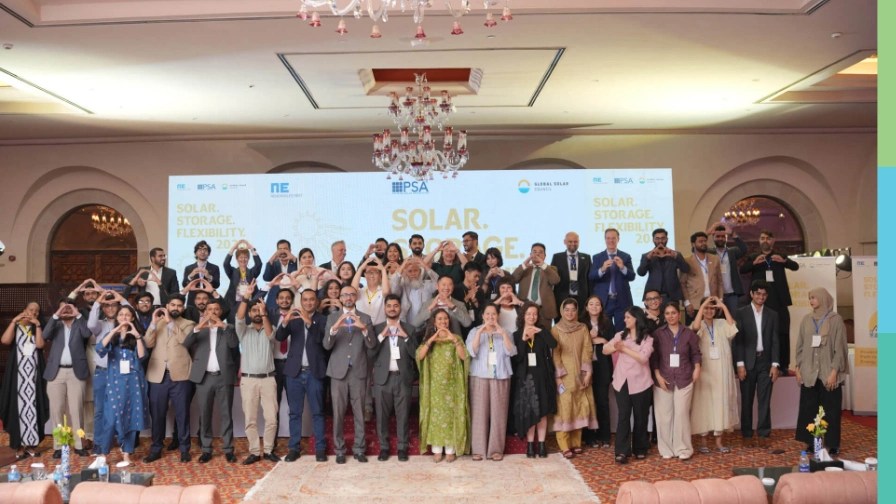
On 3-6 August, INSPIRE was represented by Yumnaa Firfirey at the Solar Storage and Flexibility Conference hosted by Renewables First, the Pakistan Solar Association, and the Global Solar Council. This conference convened policymakers, regulators, utilities, financiers, technology providers, and international partners to reposition distributed renewables, storage, and flexibility as core pillars of future energy systems and to operationalize the reforms needed to get there.
INSPIRE was tasked with presenting the topic of benefit sharing, and specifically, what Pakistan might learn from South Africa’s REIPPPP model. This required a fair amount of research into Pakistan’s energy structure, and even more grappling with just how different that structure is from our own.
These are some of the key lessons and learnings relevant to South Africa that have emerged from her time at this convening:
Pakistan’s ‘Prosumer’ context
Pakistan operates in what’s best described as a “prosumer” context. Beyond major hydro and a handful of utility-scale wind and solar installations, there’s limited government-led renewable energy deployment. Instead, the supply gap has been filled by residential, commercial, and industrial solar, with fixed capital investment coming from citizens and the private sector rather than government. This creates real challenges: fewer consumers left to cover grid maintenance costs, pushing tariffs higher for those who can’t afford to install solar themselves, and severe grid instability at peak periods when solar can’t meet demand without battery storage in place.
Pakistan’s battery manufacturing sector
Battery storage was, fittingly, one of the conference’s central themes. If citizen and private-sector-led solar was the first energy revolution, the next is citizen- and private sector-led battery storage, and Renewables First did a remarkable job convening key players in Pakistan’s battery manufacturing sector to explore how this revolution could be built on local manufacturing rather than imports.
The parallels to our own South African Renewable Energy Master Plan (SAREM) process, and its push for more robust localisation, were hard to miss. There may well be value in a bilateral engagement between the two countries on this front — perhaps between those driving SAREM and Renewables First / the Pakistan Solar Association. Given this context, benefit-sharing opportunities in the South African sense were harder to locate, though local manufacturing is a promising space.
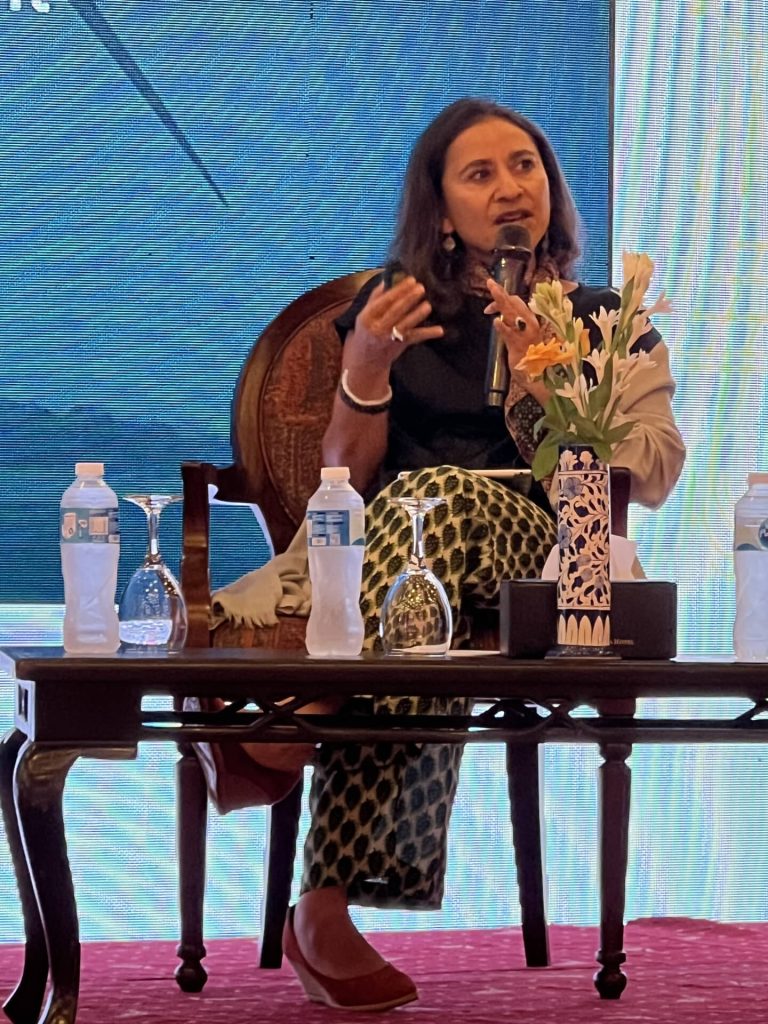
“I was encouraged to see the battery manufacturing company, NIMIR Energy making real efforts to employ local women in its manufacturing plants, alongside education and job-creation initiatives.” – Yumnaa Firfirey
Most of REIPPPP’s benefit-sharing mechanisms sit within utility-scale construction and operations, which won’t translate directly unless Pakistan moves toward utility-scale battery storage, but for now, this space looks set to remain citizen- and private sector-led too.
Virtual Power Plants (VPPs)
During the trip, Yumnaa learned more about virtual power plants (VPPs), and how these might offer an alternative to extensive grid expansion. VPPs work particularly well in distributed energy systems such as Pakistan’s, where energy is produced where it is consumed. Although, we are not entirely sure yet what applying this in the South African context would mean for a transmission line upgrade. We would be keen to hear the insights and perspectives of those working on this specific topic.
It’s worth noting that South Africa’s citizen and private sector-led solar uptake, while not quite as remarkable in relative terms as Pakistan’s, is still materially significant. South Africa’s REIPPPP, backed by offtake from Eskom and guaranteed by National Treasury, has delivered over 8,160 MW of its own operational capacity since 2011. Layered on top of that, and entirely distinct from it, citizen and private-sector solar, residential and commercial/industrial combined, has separately grown to roughly 7,300–8,300 MW as at mid-2026. This private sector and citizen-led figure alone is nothing to scoff at: it runs almost neck and neck with Pakistan’s net-metered rooftop solar capacity, which has climbed to around 7,000 MW over the same period, up from just 190 MW in 2020.
Closing remarks from Yumnaa
“The trip left me freshly appreciative of just how unique, and how visionary, South Africa’s REIPPPP programme was fifteen years ago. It’s part of why, The Initiative for Social Performance in Renewable Energy (INSPIRE), with the support of Alison McCallum and I, facilitated a group of about 20 social performance practitioners to write a book on REIPPPP, RE-wiring Social Performance.
That appreciation crystallised for me in the feedback from the panel I spoke on, “Energy, Equity and Access.” There, I shared South Africa’s REIPPPP benefit-sharing successes, as well as the areas for improvement, and I watched the realisation land differently across the room: some amazed that government-led benefit sharing like this could exist at all, others visibly wrestling with how revolutionary the idea felt, and others already asking the practical question, how could this work in Pakistan? That question is exactly why we wrote the book — not just for South Africa, but for every geography asking how utility-scale renewable energy can share its benefits with justice and impact.”
We look forward to sharing more the launch of RE-wiring Social Performance soon.