Research Reports
Do you have more resources you would like to see here? Please share them with us.
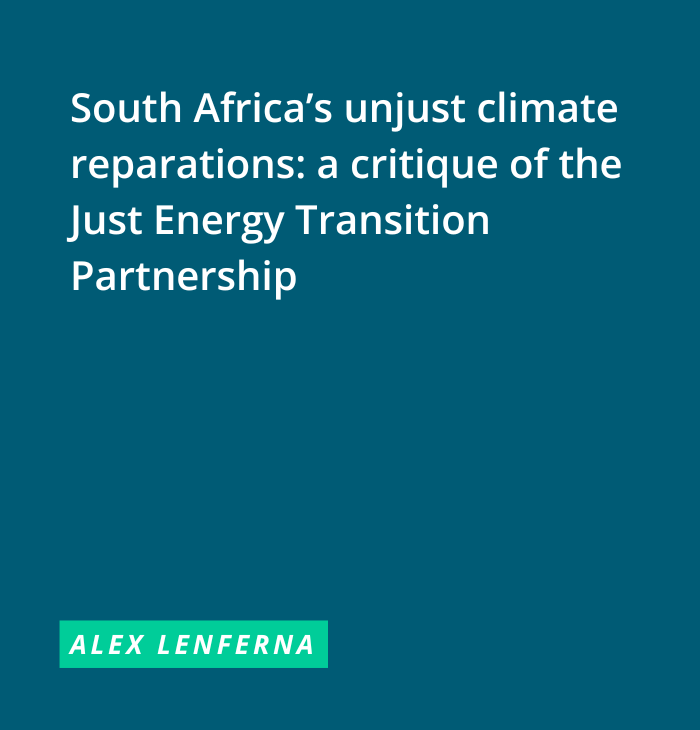
South Africa’s unjust climate reparations: a critique of the Just Energy Transition Partnership
This study discusses the moral question of whether South Africa deserves climate reparations. It examines the deeply unequal and polluting nature of the South African economy in order to demonstrate how claims from South Africa for climate finance and reparations are morally complex and fraught.

South Africa’s contested transition to energy democracy?
This report offers a collection of insights emerging from the national large-scale renewable energy programmme.

A feasibility study exploring energy access through community-led socially owned renewable energy development in South Africa
This report follows the format of first introducing the national and local energy development landscape as a background context for the study. It then deepens its focus on energy use in municipalities, covering the energy service delivery status of the 2 study municipalities (technical and policy elements), household energy use patterns of low-income households in…

Community Trust Benchmarking Report
The aim of the study is to present examples of best practice in areas which can be used to strengthen the governance and the social development intent of the current RBM trusts.

Skills for a Just Transition to a Green Future
The current study presents the initial discussion paper which seeks to explore the role TVET can and should play in a Just Transition to a Green Future and how DC can support partner countries in this endeavour.

Energy Transition Skills Project: Report
The Energy Transition Skills Project led by Student Energy, in partnership with Ørsted, explores what is most important to young people when looking for employment and what barriers they face to entering the energy transition jobs labour market. By understanding the needs and aspirations of young people, the project provides insight to young people, organizations,…

INSPIRE insights into the maturity of social performance in renewable energy in South Africa
This research report aims to specifically explore the skills gaps and training needs amongst economic development practitioners in South Africa’s Renewable Energy Programme.

Communities in transition report
Intellidex has conducted a research project into community trusts set up under South Africa’s renewable energy independent power producer procurement programme (REIPPPP). The research was funded by FirstRand.
Integrating community development in public procurement of renewable energy generation
This policy brief provides lessons learnt and associated recommendations from one particular attempt to address this issue, namely South Africa’s efforts to incorporate community development as a criteria in the auction schemes through which renewable energy is procured. This policy is implemented through the nationwide REIPPP programme, which is among the few of its kind…
The social performance approach: Fostering community well-being through energy-sector investments
This paper develops a social performance approach for energy-sector investments and energy project development. In essence, this puts the needs and well-being of people – including current and future generations – at the centre of energy development and related investments and activities. The approach can help determine whether (or not) the development and implementation of…

Scaling the just transition for community-based and community-placed projects
This paper explores the question of scaling Just Transition community projects, blending historical and empirical perspectives. Through an assessment of the design, funding, implementation and maintenance of such projects, the paper articulates the constraints and opportunities for South Africa’s historically disadvantaged communities. South Africa is indeed not new transition projects and, in some ways, can…

The role of local government in the community engagement of a renewable energy company in South Africa
The research investigated community engagement within the tripartite relationship of a wind farm, the communities around it, and the local government. It was found that local government played a moderating role in the community engagement efforts of the wind farm, which had to comply with certain engagement protocols determined by local government.